The year was 1948, on Stonecutters Island in Hong Kong when a young seaman of the Royal Navy by the name of George Hickinbottom, who had a penchant for rescuing animals, found a malnourished tuxedo kitten wandering the dockyard. He smuggled him onboard the HMS Amethyst in his coat, named him Simon, and made him the ship’s chief mouser.
The next year the Amethyst was heading up the Yangtze river to Nanking to guard the British Embassy during the Chinese Civil War. About 100 miles up river they fell under fire by the People’s Liberation Army (PLA) when they ignored the warning to stay away. Who was at fault for starting what became known as the Yangtze Incident is not my place to say. I am not a historian, nor am I familiar with the Chinese political landscape and British involvement of the time. What I can say is that many people on the Amethyst were killed or injured and the ship ran aground when trying to escape the gunfire. Attempts of escape or rescue were foiled by the PLA, and they remained stranded for ten weeks.
The bombardment severely damaged the ship and mortally wounded Captain Skinner. It has been hypothesized that Simon was sleeping in the captain’s quarters when the attack began, getting hit by shrapnel, and hiding for an unknown amount of time while the crew dealt with the aftermath. He remained undiscovered until all the wounded men had been found and treated when he immerged, singed, bloody, weak, and terrified. Petty Officer George Griffiths found him and treated him, his health slowly improving until he was able to return to his ratting duties, which were all the more important now that the ship’s supplies were limited and could not be easily restocked. He also took on another job at this time, comforting the injured and shell shocked men in the sick bay.
Lieutenant Commander John Kerans had become captain of the HMS Amethyst at this time and was the first of the captains in Simon’s experience to not like cats. He barred him from his quarters, but like most cats, Simon did not take “no” for an answer. When Kerans became ill and was confined to his bed for a few days, Simon treated him like the injured soldiers before, curling up next to him and comforting him until he recovered, fully winning him over.
After the ten weeks of their confinement was over and the Amethyst was able to return to open water, the news of Simon’s heroism began to spread. He was awarded the Amethyst campaign ribbon and the title Able Seacat. When the Armed Forces Mascot Club suggested that he be awarded the Dicken Medal, often equated to the Victoria’s Cross for animals in war, Kerans immediately signed the recommendation and Simon was awarded the 54th medal, becoming the only cat in a list of dogs, horses, and pigeons to receive it.
The return to England was not a happy one. At the tail end of the mandatory six month quarantine, on November 28th, he fell asleep for the last time after battling a fever. The date for his medal presentation was just a couple weeks away, scheduled for December 11th, and he was awarded posthumously. He had become a national hero, but none loved him more than the crew of the HMS Amethyst who would often visit him. Lieutenant Commander Kerans, who had previously barred him from his quarters, was planning on adopting him. He was buried in the PDSA’s animal cemetery by Father Henry Ross with a headstone bearing the inscription:
IN
MEMORY OF
“SIMON”
SERVED IN
H.M.S. AMETHYST
MAY 1948 — SEPTEMBER 1949
AWARDED DICKIN MEDAL
AUGUST 1949
DIED 28TH NOVEMBER 1949.
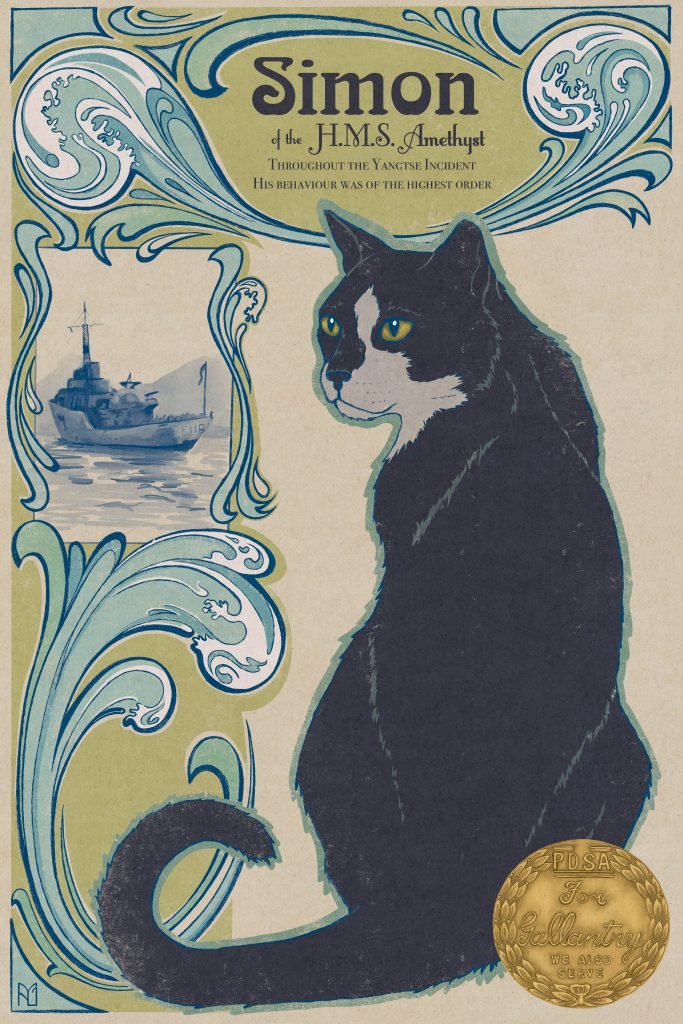
THROUGHOUT THE YANGTZE INCIDENT
HIS BEHAVIOUR WAS OF THE HIGHEST ORDER
The cemetery is open to the public and can be found at Ilford PDSA Animal Cemetery, Woodford, Ilford IG4 5PZ, United Kingdom
As I stated early, I am not qualified nor am I comfortable weighing in on the Yangtze Incident itself. My goal for this piece was to honor a hero who did his best to help his fellow sailors. Because of this, I decided against the route of including obvious Chinese imagery and iconography, opting instead to focus on his status as Able Seacat. The asymmetrical composition, crashing waves, and portrait of the ship were all inspired by early 1900s Atlantic cruise ship dinner menus, especially ones from Red Star Line, who’s most famous ship is the Titanic. These were often designed in the Art Nouveau style, which I am so partial to. I thought his job as a mouser fit the nautical food themed inspiration. The bottom right contains the Dickin Medal like a golden sticker of certification.
I got most of my information from the website Purr ‘n’ Fur, which specialize in tales about cats. If you want a much more in depth account of Simon’s life, definitely check out their article about him.

Leave a Reply